RMS power is the most reliable measure of a speaker's continuous, real-world power handling capability, while peak power only describes brief bursts. If you've ever stared at a speaker box while trying to decide what the numbers mean, RMS is the spec that matters most for keeping your audio clean and your gear safe.
You might be choosing studio monitors for a podcast setup, or checking whether a new pair of speakers will hold up in a video edit bay. The labels look technical, but the decision usually comes down to one simple question, can this speaker handle the power you'll send it for long periods without distorting or getting damaged?
Table of Contents
- Untangling the Specs What Is RMS Anyway
- What RMS Power Really Means
- RMS vs Peak vs Program Power Ratings
- Why RMS Is the Gold Standard for Audio Gear
- Matching Speakers and Amplifiers Using RMS
- Common RMS Myths and Misconceptions
- Practical Takeaways for Podcasters and Creators
- Frequently Asked Questions About Speaker Power
Untangling the Specs What Is RMS Anyway
A creator shopping for speakers usually meets the same confusing wall of numbers. One box says RMS, another says peak, and a third throws in a bigger wattage figure that sounds more impressive than the first two. That mix can make a perfectly normal purchase feel like you need an engineering degree before you can pick monitors for your desk.
RMS stands for Root Mean Square, and in speaker specs it's the best shorthand for how much power a speaker can handle continuously rather than for a split second. In audio engineering terms, that makes it far more useful than peak wattage when you're trying to match a speaker to a real system, because it reflects sustained use instead of a momentary burst. A technical explanation also notes that RMS power is about 0.707 of peak amplitude in AC terms, which is one reason RMS ratings usually look lower than peak ratings. RMS and peak watts explained
If peak power is the one-time deadlift your speaker can survive for a moment, RMS is the weight it can keep lifting rep after rep without falling apart. That's the spec that matters when you're editing voice tracks for an hour, monitoring a mix, or running playback across a long session.
Practical rule: if you only remember one number on a speaker spec sheet, make it the continuous or RMS rating.
The reason this matters so much for creators is simple. When a speaker is pushed past its continuous handling, distortion rises and the gear works harder than it should. That can make a mix sound misleading in the room, which is the last thing a podcaster or video editor wants when making decisions that affect an entire episode or cut.
What RMS Power Really Means
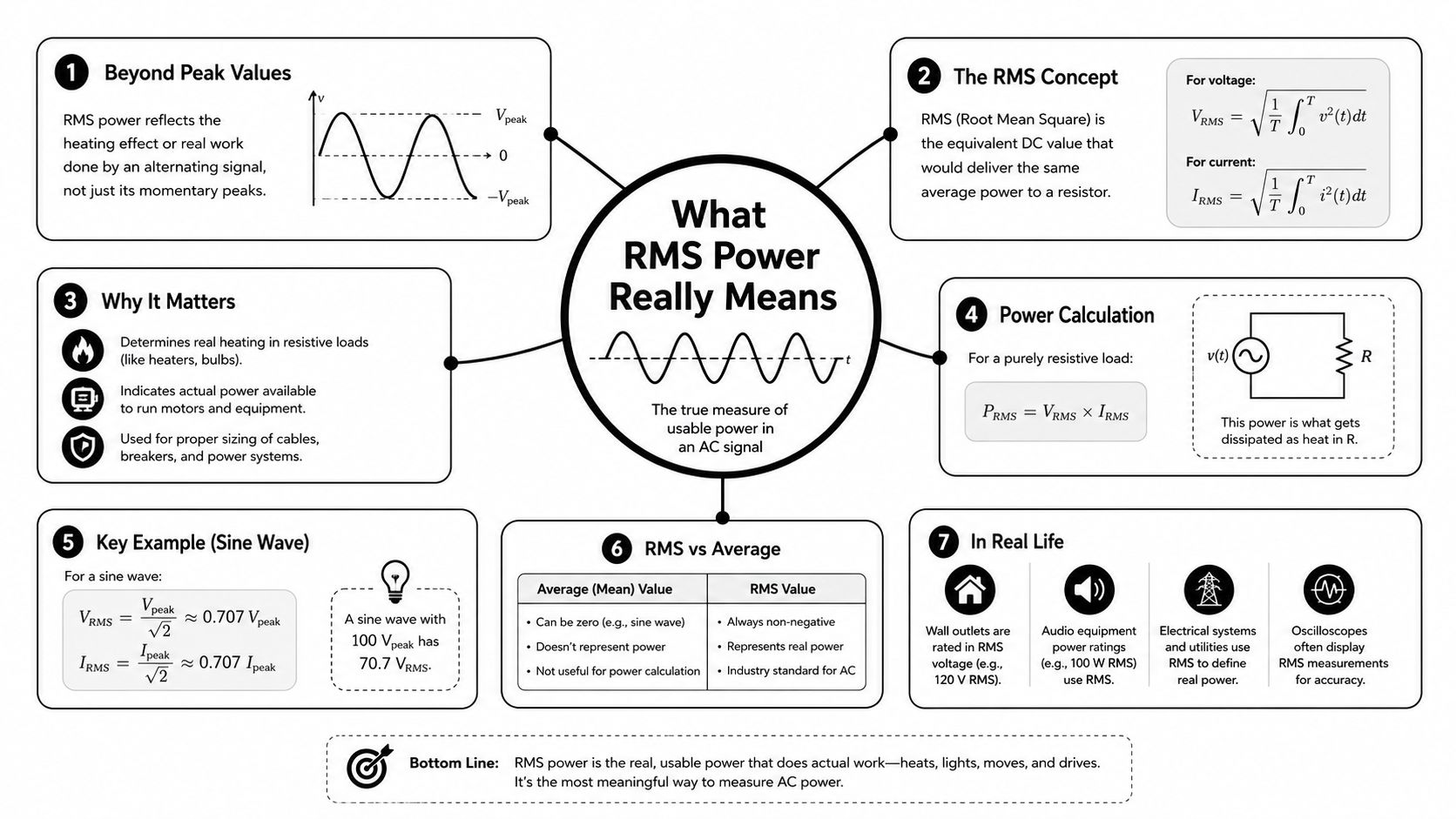
RMS is a math method that turns a changing audio signal into one stable value. Because sound waves rise and fall constantly, a plain average doesn't tell you much about the actual energy moving through the system. RMS squares the values, averages them, then takes the square root, which gives a more meaningful measure of the signal's effective power.
Why the math matters in real audio
That sounds abstract until you connect it to the speaker itself. The voice coil in a speaker heats up as power keeps flowing through it, so the continuous level matters more than a brief spike. That's why RMS has become the most practical way to talk about usable power in audio gear, especially when the signal is never steady for long. RMS in speakers
A simple analogy makes the difference easier to feel. A peak rating is like one hard sprint, useful for a short moment but not a measure of endurance. RMS is the pace you can keep without collapsing, which is why it lines up better with how speakers behave during real sessions.
For podcasters, editors, and musicians, that endurance idea is the whole point. A speaker that handles its continuous rating comfortably is less likely to distort when dialogue gets louder, a music bed swells, or a transient lands hard in the mix.
Listen for stability, not flash. A speaker that stays composed at its continuous rating usually gives you a more trustworthy monitoring chain.
A quick mental model
- Peak power is the short-lived spike.
- RMS power is the sustainable level.
- Real-world use lives much closer to RMS than to peak.
That's why RMS is the number that helps you plan around everyday listening, not just spec-sheet bragging rights. It's the closest thing to a dependable power picture for creators who need their monitors to tell the truth.
RMS vs Peak vs Program Power Ratings
Speaker spec sheets often mix three different ideas, and the names can blur together if you're moving fast. RMS, peak, and program power each describe something different, and only one of them is useful for safe day-to-day matching.
| Rating | What It Measures | Best For |
|---|---|---|
| RMS | Continuous or average power handling over time | Matching speakers and amplifiers for real use |
| Peak | Short bursts of maximum power | Describing brief transients, not everyday playback |
| Program | A middle-ground rating used in some speaker specs | Rough planning for music playback, but still less reliable than RMS |
Reading the three ratings without getting tricked
Peak power sounds exciting because it's the biggest number on the page. The problem is that it often describes a momentary burst, not something the speaker can sustain, so it can make a modest speaker look more rugged than it really is. That's why peak alone is a poor guide for a studio, podcast, or edit setup.
Program power sits between the two. In many specs, it's treated as a music-use figure, but it still doesn't beat RMS for deciding whether a speaker and amplifier are a good long-term match. For working creators, it's more of a reference point than a decision-maker.
RMS is the number you can build around. When a speaker is listed at 100 W RMS, the practical meaning is that it's being described as able to handle roughly that level continuously, while its peak figure may be much higher for brief transients. Why RMS is the continuous rating that matters
Use RMS for the decision, use peak for context. If the two conflict, trust the continuous rating.
A common trap is buying for the biggest watt number and assuming it means louder, cleaner, or better. It doesn't. Loudness and clarity depend on the whole system, and the wattage label only tells part of that story.
Why RMS Is the Gold Standard for Audio Gear
Audio signals are not flat lines. They rise, fall, pulse, and linger, which is exactly why a simple average would mislead you when you're trying to understand how much stress a speaker is under. RMS solves that by giving you a stable effective value that tracks the heating and workload a speaker sees.
The engineering reason it became standard
That's the core reason RMS stuck in electronics and audio. It gives designers, sellers, and engineers a shared language for alternating signals, where the waveform is always changing and raw peaks can make a system look stronger than it really is. In practice, that means RMS is tied much more closely to thermal stress on the voice coil than peak wattage is.
For creators, that has a direct payoff. If you monitor through speakers that are being pushed beyond their continuous rating, the sound can harden, smear, or break up in ways that make your edit decisions less trustworthy. You might trim dialogue too aggressively, under-correct music levels, or miss a problem because the speaker itself is starting to lie to you.
Manufacturers know that big peak numbers attract attention. That doesn't automatically make those numbers false, but it does mean they're easy to misuse in marketing because they look stronger than the everyday listening reality. RMS keeps the focus on usable performance instead of temporary maximums.
What the better spec protects
- Your ears, because a cleaner speaker is easier to work with for longer sessions.
- Your monitors, because sustained overdrive can raise distortion and stress.
- Your mix decisions, because a stable speaker response gives you a truer reference.
The practical lesson is straightforward. If you're choosing gear for editing or monitoring, RMS is the spec that best tells you whether the speaker can handle the job without getting flaky under normal use. Peak may grab attention, but RMS protects the workflow.
Matching Speakers and Amplifiers Using RMS
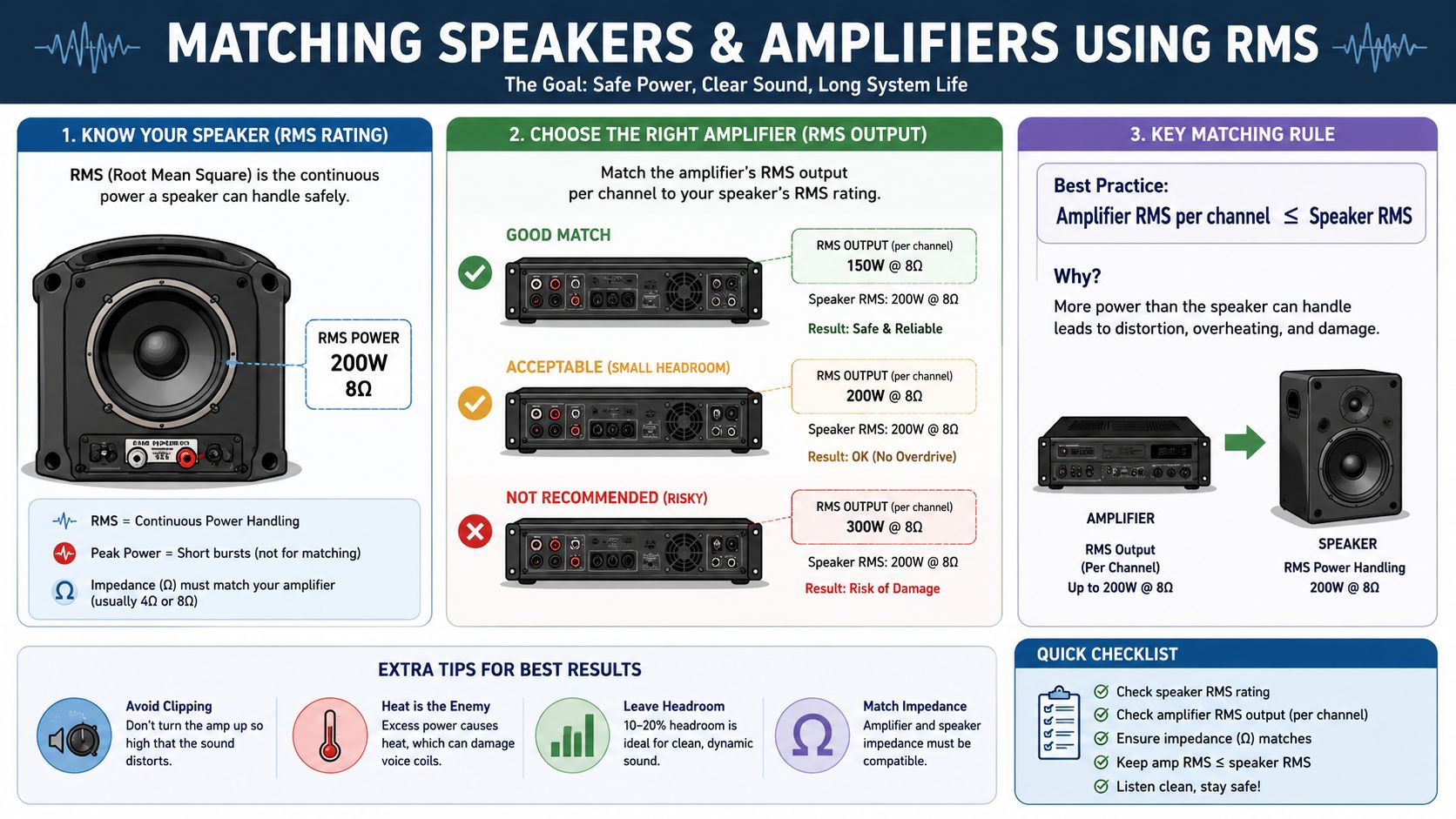
The cleanest way to match a system is to start with the speaker's RMS rating and work backward to the amplifier. That's because the speaker is the part most likely to suffer if the chain is mismatched, and the continuous rating gives you the safest baseline for real use.
A simple matching rule
If the amplifier's usable output is wildly below the speaker's continuous rating, you may end up turning things up too far and clipping the amp before the speaker is getting enough clean power. If the amplifier is far above the speaker's rating, the system can be pushed into overload very quickly if someone turns the level up without caution.
The goal is balance. In practice, many creators look for an amplifier whose RMS output per channel sits close to the speaker's continuous handling, with enough breathing room to avoid clipping during normal dynamic changes. That breathing room is what audio people usually mean when they talk about headroom.
A workable example is a setup built around speakers rated around the same continuous class as the amp's per-channel RMS output. That kind of pairing gives you room for transients without making the system fragile. It also keeps the monitoring chain predictable, which matters when you're making judgment calls on dialogue, music, or sound design.
Headroom is not a license to ignore ratings. It's a buffer for normal dynamics, not a reason to overpower the speaker.
What to do in your own setup
- Check the speaker's RMS rating first.
- Look at the amplifier's RMS output per channel.
- Avoid relying on peak numbers to make the match.
- Leave room for dynamic changes, but don't treat extra power as free volume.
For creators, this is less about audiophile purity and more about workflow safety. A well-matched system lets you monitor at a sensible level, hear clipping before it sneaks into a session, and avoid the ugly distortion that can derail an otherwise solid recording.
Common RMS Myths and Misconceptions
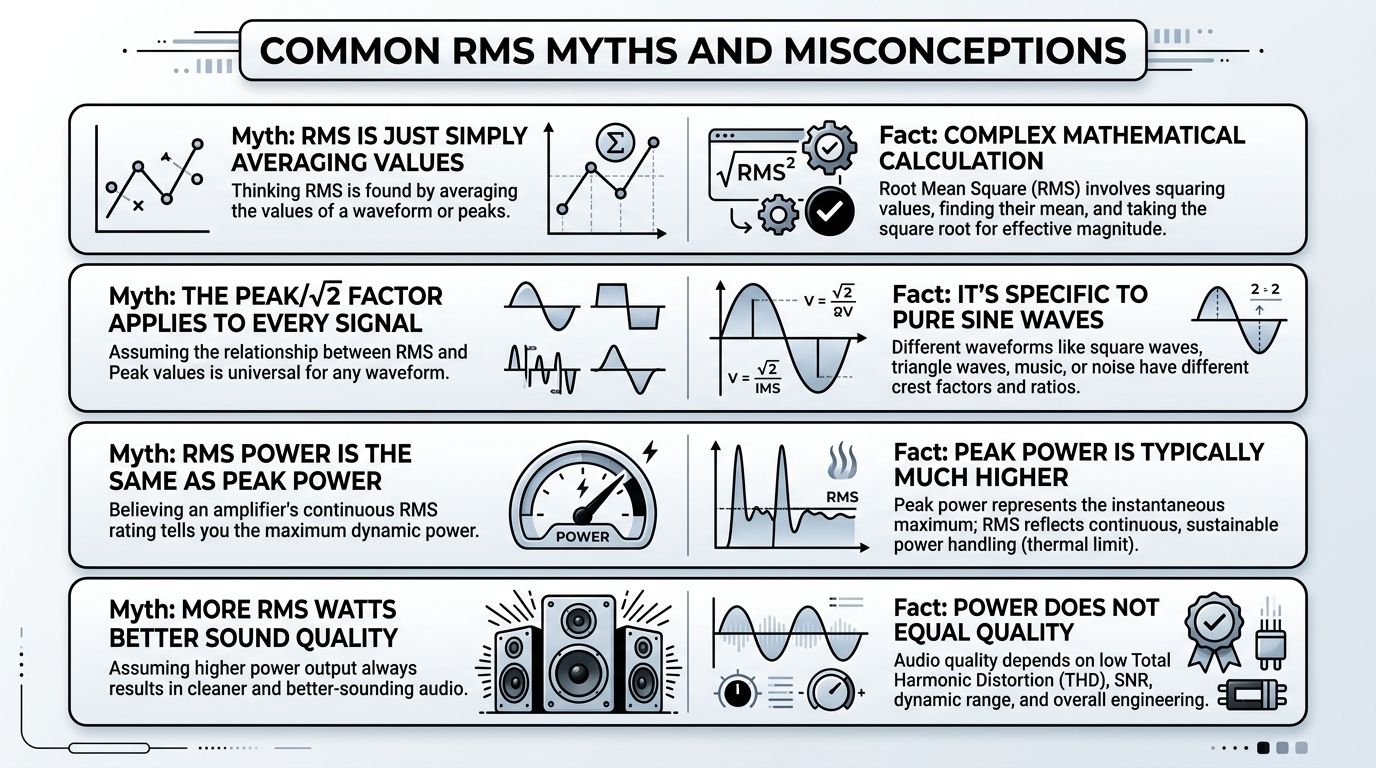
One of the biggest myths is that more watts always means better sound. That's not how speakers work. A well-matched, lower-powered system can sound cleaner and be far more useful than a mismatched setup with a bigger number on the box.
Myth one, peak is the most important spec
Peak power gets a lot of attention because it's the largest figure. For real-world work, though, it tells you very little about how the speaker behaves during a long edit session, a podcast recording, or a music playback check. RMS is the spec that reflects continuous use, which is what creates heat, strain, and the possibility of damage.
Myth two, you can never have too much power
Too much available amplifier power can be risky if the system is used carelessly. The core issue isn't just wattage, it's how the speaker is driven over time. Sustained overdrive and distortion are what wear gear down and make monitoring less reliable.
Myth three, watts tell you loudness by themselves
Watts matter, but they don't tell the whole story. Speaker efficiency, room acoustics, and placement all affect what you hear. That's why two systems with similar wattage ratings can feel very different in the same room.
Don't buy watts. Buy the ability to play cleanly at the level you actually use.
The safest habit is to treat RMS as the anchor and everything else as supporting context. That one habit helps you avoid inflated marketing claims and keeps the focus on clean monitoring, not spec-sheet theater.
Practical Takeaways for Podcasters and Creators
For podcasters, YouTubers, and editors, the meaning of RMS in speakers comes down to trust. A monitor that's rated for continuous use appropriately is more likely to show you real problems, like harsh dialogue, buried ambience, or harsh transients, without adding its own distortion on top.
That matters because bad monitoring leads to bad choices. If your speakers are straining, you may compensate in the wrong direction, and those mistakes show up later in the mix, the export, or the final upload. Clean, distortion-free playback gives you a better starting point before any finishing tools enter the picture.
What to prioritize in a creator setup
- Continuous power handling first, because that's the realistic operating limit.
- Clean amplifier matching, because clipping is easier to hear and fix before it reaches the speaker.
- Stable monitoring levels, because consistency helps your ears judge edits more accurately.
If you're working on spoken-word content, the benefit is especially obvious. Dialogue that sounds controlled on a properly matched speaker is easier to edit, easier to normalize, and easier to place against music or effects without guesswork.
Frequently Asked Questions About Speaker Power
Can an amplifier have more RMS power than the speaker?
Yes, but only if you use it carefully and keep levels under control. More available power can give you useful headroom, but if the speaker is pushed too hard for too long, distortion and damage become more likely.
Does RMS mean a speaker sounds better?
No, RMS doesn't measure sound quality by itself. It tells you about continuous power handling, which helps you avoid overload and distortion, but the overall sound still depends on the speaker design, the room, and how the system is set up.
Is peak power useless?
No, it just isn't the number to trust for everyday matching. Peak can tell you something about short transients, but it doesn't replace the continuous rating when you're choosing gear for real use.
Does this apply to headphones too?
The same basic idea, continuous power versus short bursts, still matters, but headphone specs and usage are different enough that you shouldn't read them exactly like speaker specs. For headphones, sensitivity and impedance become even more important in practice.
If you want cleaner audio from the start, build your monitoring chain around the true meaning of RMS and not the biggest number on the box. Visit ClearAudio to see how a simple prompt can help you clean up noisy recordings, isolate dialogue, and turn rough audio into something ready to publish.