You're lying in bed when the neighbour's footsteps start above you. Each heel strike arrives as a dull thud, followed by the scrape of a chair and the small shock of something dropped on the floor. Or perhaps you're recording a podcast at home, and the microphone catches every floorboard creak that your ears had learned to ignore.
Noise reduction underlay can make a major difference in these situations, but it isn't a universal soundproofing layer. It works most effectively against impact noise, the vibration created when feet, furniture, or objects hit a floor. It's much less effective against airborne noise, such as voices, television, or music travelling through walls, ceilings, doors, and gaps.
The buying decision becomes clearer once you identify the noise path. A resilient layer beneath the floor finish can interrupt vibration before it enters the subfloor, but it can't remove sound that's already travelling through the air inside your room. The right product also depends on the floor construction, the finish above it, installation method, and the test standard behind its performance claim.
Table of Contents
- What Noise Reduction Underlay Actually Does
- Acoustic Metrics Explained Without the Jargon
- Comparing Rubber, Foam, Cork, and Fibre Underlays
- Matching Underlay to Your Flooring Type
- Choosing the Right Underlay for Your Situation
- Real Use Cases for Quieter Spaces
- Installation Basics That Make or Break Performance
- Where Underlay Ends and Audio Cleanup Begins
What Noise Reduction Underlay Actually Does
A floor can turn an ordinary movement into a structural event. Hard flooring passes the energy from a heel strike into the subfloor, where joists, concrete, ceilings, and connected walls can carry the vibration onward. That's why a footstep upstairs may sound louder in the room below than it did at its point of origin.
Underlay sits between the subfloor and the visible floor finish. Its resilient structure acts a little like a trampoline under a moving foot. Instead of allowing the full force of the impact to enter the building immediately, it flexes, spreads, and damps part of that energy. A soft, controlled material also resembles a sponge for vibration. It doesn't make the impact disappear, but it reduces the sharp transfer into the structure.

The noise distinction that changes the purchase
Impact noise begins at the floor. Footsteps, dropped toys, chair movement, and objects striking the surface all fall into this category. Underlay is designed primarily to reduce that vibration, especially when it forms part of a floating-floor assembly.
Airborne noise starts in the air. A neighbour's conversation, television, or music reaches you through separating walls, ceilings, doors, vents, and other openings. Underlay may make a room feel less reflective, but it usually won't provide the mass, sealing, and isolation needed to block those sounds effectively.
Practical rule: Choose underlay for the nuisance you can trace to the floor, not for every sound you hear in the room.
Field measurements show why the layer matters. In an Australian acoustic-results dataset, a bare 200 mm slab measured LnT,w 68 dB, while the 14.5 mm AIRSTEP Premier Pad reduced the measured result to 29 dB and reached FIIC 77. Several products in the same report achieved 35 to 39 dB improvements, with 51% to 57% reductions compared with the bare slab. These are assembly results, not promises for every home, but they demonstrate why underlay is a core part of floating-floor sound control systems. The field acoustic results show the practical difference between an untreated structure and a tested floor build-up.
Underlay is therefore one tool in a wider acoustic system. It can soften footfall and impact transmission substantially, while airborne noise may require ceiling treatment, wall mass, sealing, rugs, furnishings, or a combination of measures.
Acoustic Metrics Explained Without the Jargon
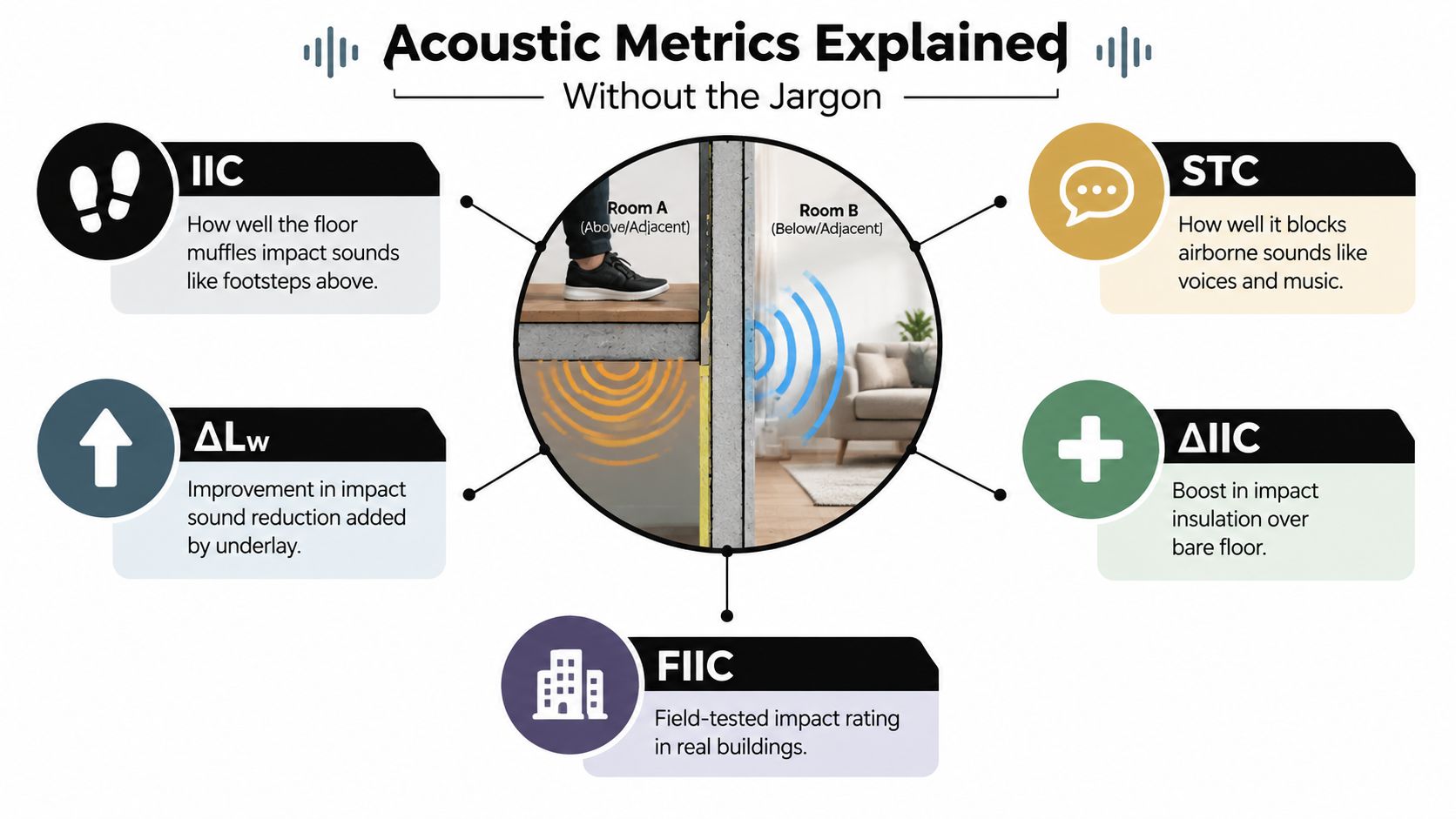
Acoustic ratings become less intimidating if you treat the floor like a wall between two rooms. Tap on the floor above, and you're testing how well the assembly controls impact. Speak through the wall, and you're testing how well it blocks airborne sound.
IIC, or Impact Insulation Class, describes how effectively a floor and ceiling assembly limit impact noise. A higher rating generally means better protection from sounds such as footsteps and dropped objects. STC, or Sound Transmission Class, addresses airborne sound, including speech, television, and music. Mixing these ratings is one of the most common mistakes in product comparisons.
What the delta ratings tell you
Underlay data often uses ΔLw, the weighted reduction in impact sound. It represents the improvement associated with the tested floor covering or underlay system under a specified laboratory method. ΔIIC serves a similar purpose in an IIC-based rating system, showing the boost over a reference floor.
FIIC means Field Impact Insulation Class. The word “field” matters because the measurement comes from a real building rather than only a controlled laboratory assembly. A field result includes the influence of the actual slab, ceiling, junctions, workmanship, and flanking paths.
A certified recycled-rubber underlay reports ΔLw of 18 dB under UNI EN ISO 10140-3:2021, with reductions above 40 dB at 5 kHz in its frequency data. That result is useful for understanding the product's tested behaviour, but it isn't a guarantee that the same assembly will perform identically in a particular apartment. The accredited laboratory test provides the relevant test context.
How to read a product sheet
Use these questions before comparing headline numbers:
- What metric is shown? ΔLw and ΔIIC concern impact performance. STC concerns airborne sound.
- What finish was tested? Laminate, timber, vinyl, and tile change the behaviour of the assembly.
- Was the result measured in a laboratory or the field? FIIC reflects a completed building more closely than a laboratory-only rating.
- What standard supports the claim? A test method gives the number meaning.
- Does the product retain its shape? Density and compressive strength affect whether joints collapse and the acoustic separation survives use.
A practical residential target is often around 14 dB or higher for a meaningful improvement, while higher-grade products commonly sit around 18 dB and above, provided the full assembly supports that result. MMFA guidance on underlay materials explains why manufacturers should test the underlay with the selected floor finish rather than extrapolate from a standalone material.
The decibel scale is logarithmic, so a higher figure isn't a simple promise of twice the quietness. A rough listening guide is that adding 10 dB can feel like halving perceived loudness, although the experience depends on frequency, source, and the listener.
Comparing Rubber, Foam, Cork, and Fibre Underlays
No material wins every acoustic contest. Rubber generally suits buyers focused on impact transmission because its mass, elasticity, and damping can work together to absorb footfall energy. Recycled rubber can be especially useful beneath floating laminate or timber systems, although its weight, thickness, odour, and possible interaction with vinyl adhesives or finishes need checking before installation.
Foam underlays, including PE, IXPE, and EVA products, appeal when you need a thin and economical layer beneath laminate or a compatible click floor. They can reduce some footfall harshness and help with minor surface irregularities, but a light foam product shouldn't be mistaken for a heavy acoustic system. Compression strength matters as much as softness, particularly beneath click-lock joints.
Cork offers a firm, natural resilient layer with useful damping characteristics. It can pair well with engineered timber and may improve the room's acoustic comfort without the heavier feel of rubber. Moisture control is essential, since cork isn't the right choice for a damp or poorly prepared subfloor.
Fibre products, including wood fibre, felt, and recycled acoustic mats, provide another route for laminate, timber, and some tile systems. They can add a stable, warm layer, but the specification must account for long-term compression. A material that feels impressive on installation day may lose its decoupling effect if furniture loads flatten it.
| Material | Best For | Watch Out For |
|---|---|---|
| Rubber | Impact noise, concrete slabs, demanding floating-floor assemblies | Weight, thickness, compatibility with vinyl, adhesive, and warranty requirements |
| Foam | Laminate and compatible click floors where a thin layer is needed | Modest acoustic gains, joint movement, and low compressive strength |
| Cork | Engineered timber, natural materials, and balanced acoustic comfort | Moisture exposure and excessive deflection |
| Fibre | Laminate, timber, selected tile systems, and broader acoustic coverage | Compression over time and the need for a firm, compatible base |
The important comparison isn't “which material is best?” It's “which material has the right stiffness, damping, density, and compatibility for this floor?” For a broader flooring-focused comparison, compare foam cork rubber underlayment offers useful context on how these choices relate to hard-floor installations.
Matching Underlay to Your Flooring Type
A product can have strong laboratory figures and still be unsuitable for your floor. Flooring manufacturers specify limits for thickness, compression, moisture, adhesives, heating systems, and joint movement because the finish above the underlay must remain stable.
| Flooring | Recommended Underlay | Key Constraint | Watch Out For |
|---|---|---|---|
| Floating laminate | Medium-density foam, fibre, or a tested acoustic laminate underlay | Click-lock joints need support | Excessive softness can cause movement, gaps, or joint failure |
| Engineered timber | Cork, fibre, rubber, or a system approved by the flooring maker | The assembly must control deflection | A thick resilient layer may make boards feel unstable |
| Vinyl and LVT | High-density, low-compression product only when approved | Vinyl can reveal movement and imperfections | Dense rubber may cause dimpling, telegraphing, or warranty problems |
| Tile and stone | Stiff, water-resistant acoustic mat compatible with mortar | The bond needs a stable substrate | Compressible material can crack grout or create hollow spots |
| Carpet | Dense, resilient carpet cushion | Cushion must support the carpet backing | An overly soft pad can affect wear and furniture stability |
Floating hard floors
Laminate and engineered timber often benefit from a resilient layer that absorbs footfall without allowing the boards to bounce excessively. Cork and medium-density fibre can work well where the manufacturer permits them, while a tested rubber system may be preferable when impact control is the primary concern.
The underlay should support the click-lock mechanism continuously. If it crushes beneath concentrated loads, the floor may develop movement, creaking, or open joints. A thicker product isn't automatically better.
Vinyl needs extra caution
Luxury vinyl plank and tile can be sensitive to compression and surface irregularities. Dense rubber may perform strongly over a concrete slab acoustically, yet still be a poor choice under a particular vinyl product if it allows dimples, telegraphs imperfections, or conflicts with the warranty.
Always read the flooring installation instructions first. A manufacturer-approved thin layer is safer than forcing a high-performing acoustic material into an incompatible build-up.
Tile and carpet behave differently
Tile and stone need stiffness and moisture resistance because the mortar bond cannot float on a soft cushion. Carpet already softens the contact between foot and floor, so a properly selected dense pad often produces the clearest improvement in everyday quietness and underfoot comfort.
Choosing the Right Underlay for Your Situation
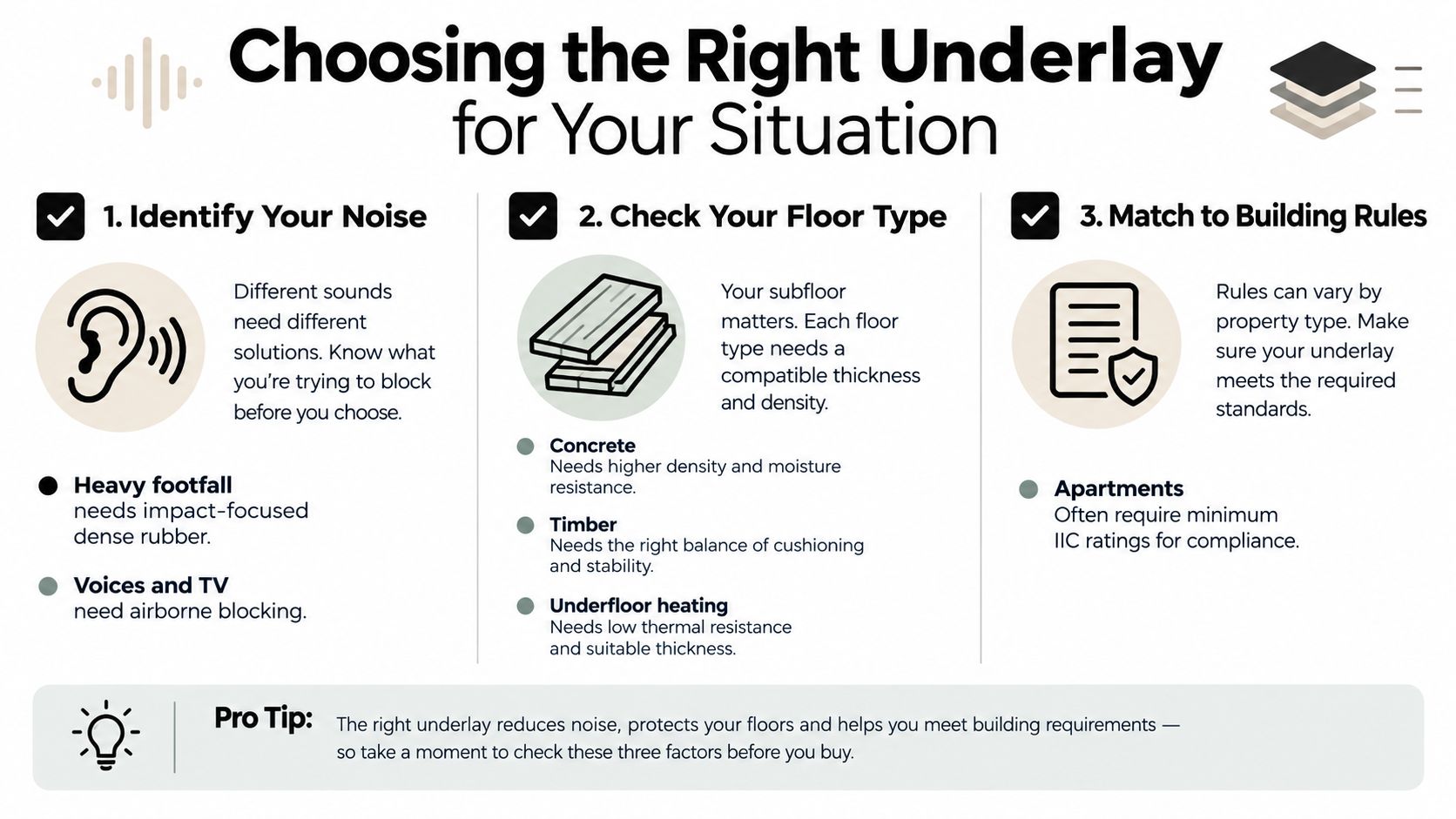
The highest dB figure isn't necessarily the right purchase. Start with three filters: the nuisance, the subfloor, and the floor finish. This order prevents an impressive rating from distracting you from a basic compatibility failure.
Begin with the sound you want to reduce
If the complaint is heavy footfall travelling downward, prioritise an impact-focused system. Dense rubber, a suitable fibre mat, or dense cork may be more relevant than a thin general-purpose foam.
If the complaint is a conversation or television coming through a separating wall, underlay alone isn't the main answer. Airborne noise needs mass, airtightness, and isolation in the wall or ceiling assembly, while soft furnishings can reduce reflections within the room.
Then inspect the structure
Concrete slabs can transmit vibration efficiently, so dense resilient layers and a carefully detailed floating floor may be appropriate. Timber joist floors behave differently. They often need decoupling and damping that work with the joist assembly rather than adding a firm layer above it.
The floor finish can override both preferences. A product that suits concrete and laminate may be unsuitable beneath click vinyl or tile. Check the manufacturer's installation system, not just the underlay brochure.
Rank the data sheet
Give the greatest weight to the details that match your problem:
- ΔLw or ΔIIC: Evidence of impact improvement, provided the tested finish resembles yours.
- Density: A clue to mass and resilience, but not a complete performance prediction.
- Compression strength: Helps indicate whether the layer will support joints, furniture, and traffic.
- Thickness: Relevant to build-up height, doors, thresholds, and deflection, but not a standalone quality score.
- System certificate: More useful than a generic material claim because it identifies the floor assembly.
Buyer's test: If the sheet doesn't identify the floor finish, subfloor, test method, and installation conditions, treat its headline number as incomplete information.
Real Use Cases for Quieter Spaces
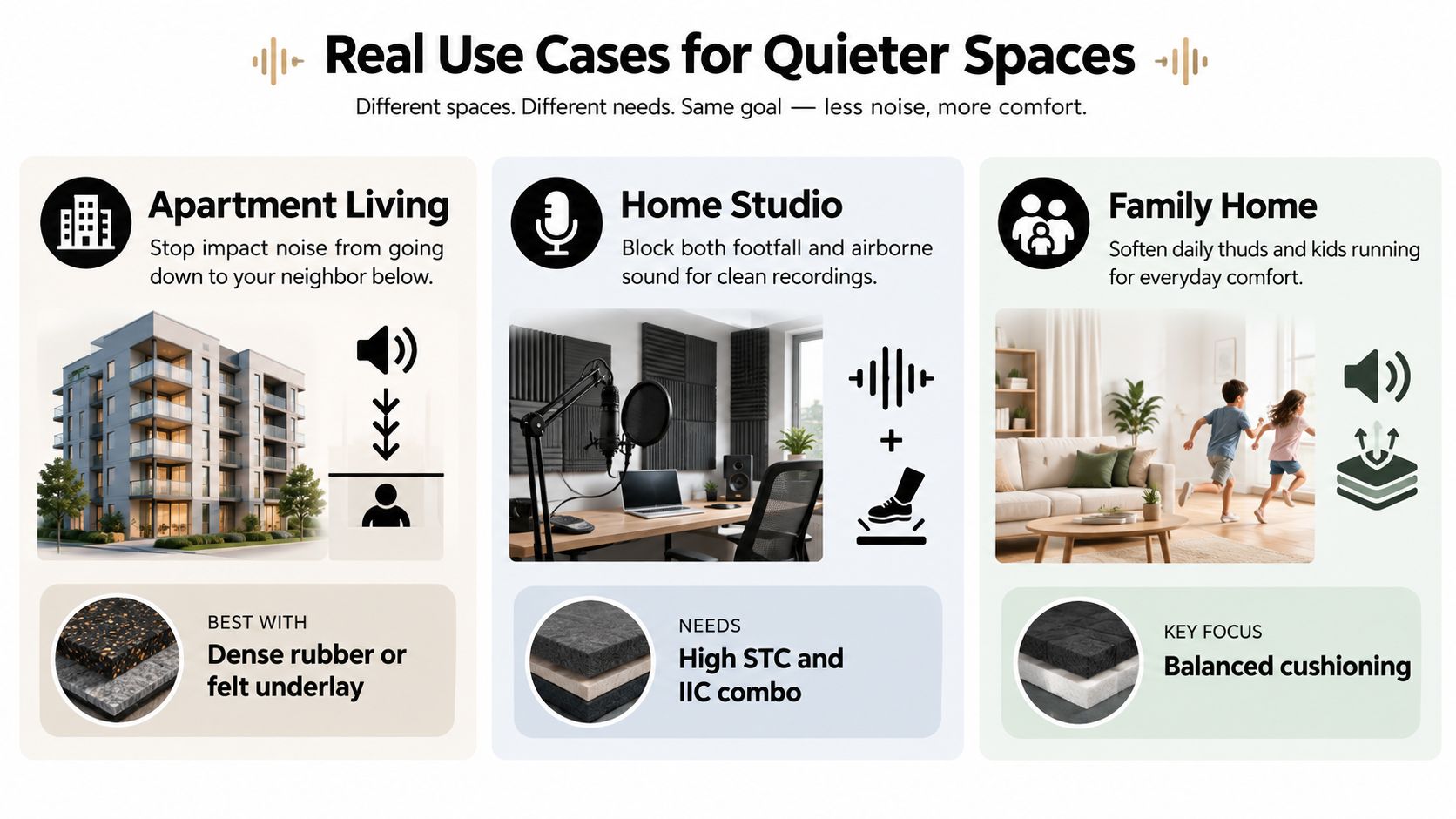
The same roll of underlay can be a sensible choice in one room and a poor one in another. Noise direction, recording requirements, furniture loads, and the floor finish all change the specification.
Apartment living
An upstairs apartment owner may be trying to reduce the sound reaching a neighbour below. Here, the target is impact transmission, so a dense rubber or high-density fibre system beneath a compatible floating floor can be more useful than a soft, lightweight foam.
The underlay still has limits. Footfall can also travel through walls, skirtings, pipes, and structural junctions. If the room below remains disturbed, treatment at the ceiling, careful perimeter detailing, and softer surface furnishings may need to join the floor solution.
Home recording
A home studio has two separate acoustic problems. The first is structural, preventing footsteps and floor vibration from reaching the microphone or nearby rooms. The second is airborne, controlling voices, road noise, ventilation hum, computer fans, and room reflections.
A floating floor, resilient layer, rug, and dense pad can reduce contact noise. A recording space may also need wall and ceiling isolation, sealed windows, and internal acoustic treatment. Underlay won't remove airborne sound after it has entered the microphone.
Office or clinic
A commercial office or clinic must balance acoustic comfort with stable movement under rolling chairs, cabinets, and equipment. A resilient rubber system may provide useful impact damping, but its compression behaviour and compatibility with the chosen floor finish need close review.
Speech privacy is a different priority from chair noise. If conversations are carrying between rooms, the separating construction, doors, glazing, seals, and ventilation routes deserve attention. Underlay can support a quieter floor experience without becoming a substitute for airborne sound control.
A family home follows the same logic. Daily thuds and running feet are impact sources, so a balanced, durable cushion may matter more than the maximum laboratory rating.
Installation Basics That Make or Break Performance
A good underlay can fail through poor detailing. The layer needs to remain resilient, continuous where the system requires continuity, and isolated from rigid bridges that carry vibration around it.
Prepare the base
Begin with a clean, sound, reasonably level subfloor. Repair loose boards and squeaks before covering them. On concrete, follow the flooring and underlay manufacturer's moisture-testing requirements and install the specified moisture barrier where the system calls for one.
Allow the materials to acclimate according to their product instructions. Then lay the underlay in the direction required by the flooring system, commonly opposite to the plank direction, so seams don't line up unnecessarily.
Protect the floating effect
Place sheets or rolls tightly together without unwanted gaps or bulky overlaps. Seal seams with the specified acoustic or system tape, not random household tape that may fail over time. Keep the resilient layer from turning into a rigid bridge at walls, doorways, and service penetrations.
Leave the required expansion space around the perimeter, commonly 10 mm where the flooring manufacturer specifies that dimension. The skirting or trim should cover the gap without pinning the floating floor to the wall.
Treat thresholds as acoustic details
Use transition strips at doorways and follow the product instructions for separating floor zones. Running the same floating layer continuously through every room can create unwanted movement and may undermine the intended acoustic breaks. Don't nail through an acoustic mat into joists, because the fastener creates a direct vibration path and defeats decoupling.
Glue-down and nail-down floors transfer vibration differently from floating systems. The installation method must match the tested assembly, or the published result may no longer describe what you've built.
Sanity check: Walk or stomp in the room above after installation. The impact should sound dull and controlled, not sharper or more resonant than before.
Where Underlay Ends and Audio Cleanup Begins
Underlay is a structural intervention. It reduces vibration at the floor, especially when footsteps, chair movement, or dropped objects are the nuisance. Once unwanted sound has become airborne inside your recording space, a layer of cork, rubber, or foam beneath the floor can't reach into the microphone signal and remove it.
That boundary matters to podcasters and video creators. You may need to stop footfall from travelling into the room, while also cleaning a recording that contains HVAC hum, laptop fan noise, street sound through a window, refrigerator drone, or room echo. Those are related problems, but they need different tools.
Two problems, two workflows
For sound travelling to neighbours, work on the building:
- Improve the floor assembly with compatible impact-focused underlay.
- Preserve decoupling around edges, seams, and transitions.
- Add rugs or dense pads where surface impacts occur.
- Address ceilings, walls, doors, and flanking routes if airborne sound remains intrusive.
For sound captured by a microphone, use recording technique and post-production. Place the microphone close to the speaker, reduce reflective surfaces, control the room source where possible, and process the finished file without removing natural voice character.
ClearAudio is one browser-based option for the second task. It lets users upload an audio or video file, specify what to keep, such as speech, dialogue, vocals, or music, and apply AI cleanup for noise, hum, hiss, room echo, dialogue isolation, and stem separation. Its available quality modes range from quick processing to more demanding restoration, so the workflow can suit a simple voice memo or a larger post-production file.
For broader building guidance, especially if your project involves regional construction conditions, soundproofing advice for Texas homeowners provides additional context on treating a home as a complete sound path rather than relying on one material.
The practical sequence is straightforward. Treat the floor first if you need to reduce vibration and neighbour complaints, then clean the recorded audio to address noise that the building treatment can't remove. The combination works because each method handles a different part of the sound path.
ClearAudio helps podcasters, video editors, musicians, journalists, and teams clean audio or video in the browser by reducing noise, hum, hiss, room echo, and unwanted content while isolating speech, dialogue, vocals, or music. Upload a recording, choose what you want to keep, and visit ClearAudio to prepare clearer audio for publication.