You're in the edit bay, the room is dark, and the scene needs one sound: a snake hiss under a tight close-up. You search your library, audition clip after clip, and they all blur together, thin, overcooked, or oddly theatrical. That's the problem with the sound of a snake hissing in most libraries, it gets treated like one effect when it's really a set of very different acoustic events.
Table of Contents
- Why the Sound of a Snake Hissing Matters for Creators
- What a Snake Hiss Actually Is
- Anatomy of a Hiss in Four Phases
- Why Snakes Hiss in the First Place
- Recording a Real Snake Hiss in the Field
- Cleaning and Isolating a Hiss Recording in Post
- Choosing the Right Hiss for the Right Scene
Why the Sound of a Snake Hissing Matters for Creators
A late-night edit can make the mismatch obvious fast. If a hiss lands under a threat shot and sounds too bright, too wet, or too constant, the audience stops reading danger and starts hearing stock audio. That break in trust is tiny, but it changes the scene.
The better approach is to treat a hiss like a performance with a body, not a generic noise. The sound of a snake hissing can be deep and guttural, airy and bright, short and clipped, or extended and layered, depending on what the animal is doing and which snake it is. A viper-style hiss and a grass-snake hiss do not communicate the same emotional texture.
Practical rule: if the hiss feels interchangeable with steam or air escaping a pipe, it probably isn't specific enough for close visual storytelling.
That specificity matters in film, podcasts, games, and nature explainers because sound carries character before viewers consciously identify it. A snake that sounds broad and low can feel heavier and more dangerous, while a brighter hiss can feel nervous or quick-tempered. The scene reads differently even when the picture doesn't change.
The rest of this guide keeps that creator's problem in view. The point is not just to recognize a hiss, but to choose, capture, and shape one that matches the species, the breath phase, and the emotional job of the scene.
What a Snake Hiss Actually Is
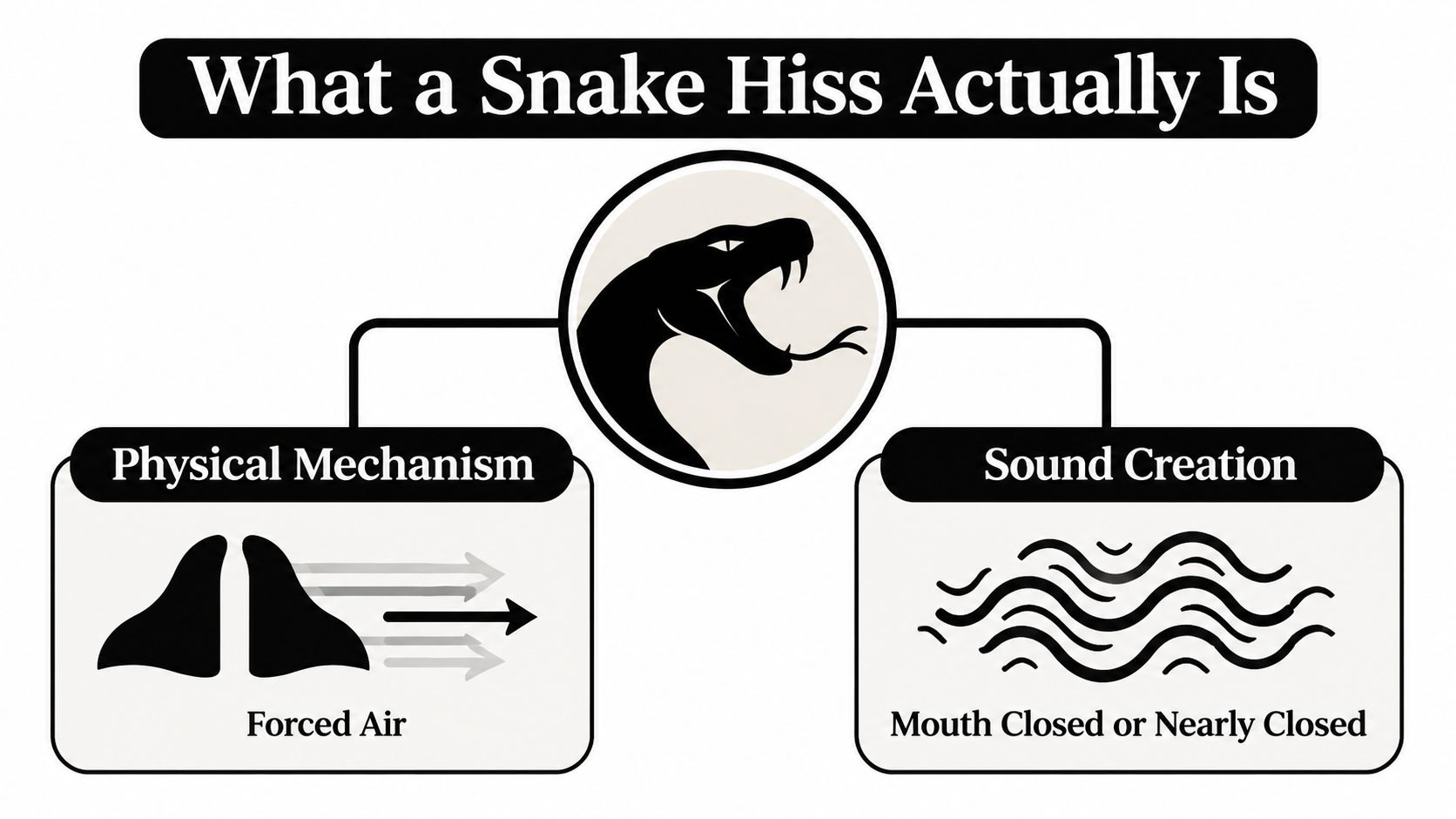
A hiss starts with forced air moving through a narrow opening, usually while the mouth is closed or nearly closed. Think of a small leak in a tire valve or steam forced through a tight seam, the sound is not a note but turbulent air shaking the surrounding space. That's why the result feels more like a rush than a pitch.
Turbulence, not a tuned voice
A snake does not produce a mammal-style vocal sound. There are no vocal cords shaping a melody, just air moving quickly through a restricted passage and creating broadband noise. In plain language, broadband noise means the sound spreads across a wide range of frequencies instead of settling into one clean tone.
That wide spread is why a hiss often feels hard to pin down in a mix. It can sit in the same general territory as wind, room noise, or harsh breath, which is why editors sometimes bury it without realizing it. Once you know it's turbulence, you stop listening for a “note” and start listening for texture.
A useful mental image is a whisper pushed too hard through a narrow opening. The sound is all edge and friction, not melody.
Why the spectrogram looks messy
A spectrogram of hiss does not draw a neat line the way a flute or whistle might. It tends to show a cloudy band of energy, which is exactly what you want for intimidation, because the ear hears something active but not easily localizable. That low-information quality is part of the effect.
For creators, the key takeaway is simple. A real hiss is a mechanical air event, and the job in post is to preserve that rough, turbulent character without letting room noise or recording artifacts take over. Once you hear it that way, the rest of the analysis becomes much easier to use.
Anatomy of a Hiss in Four Phases
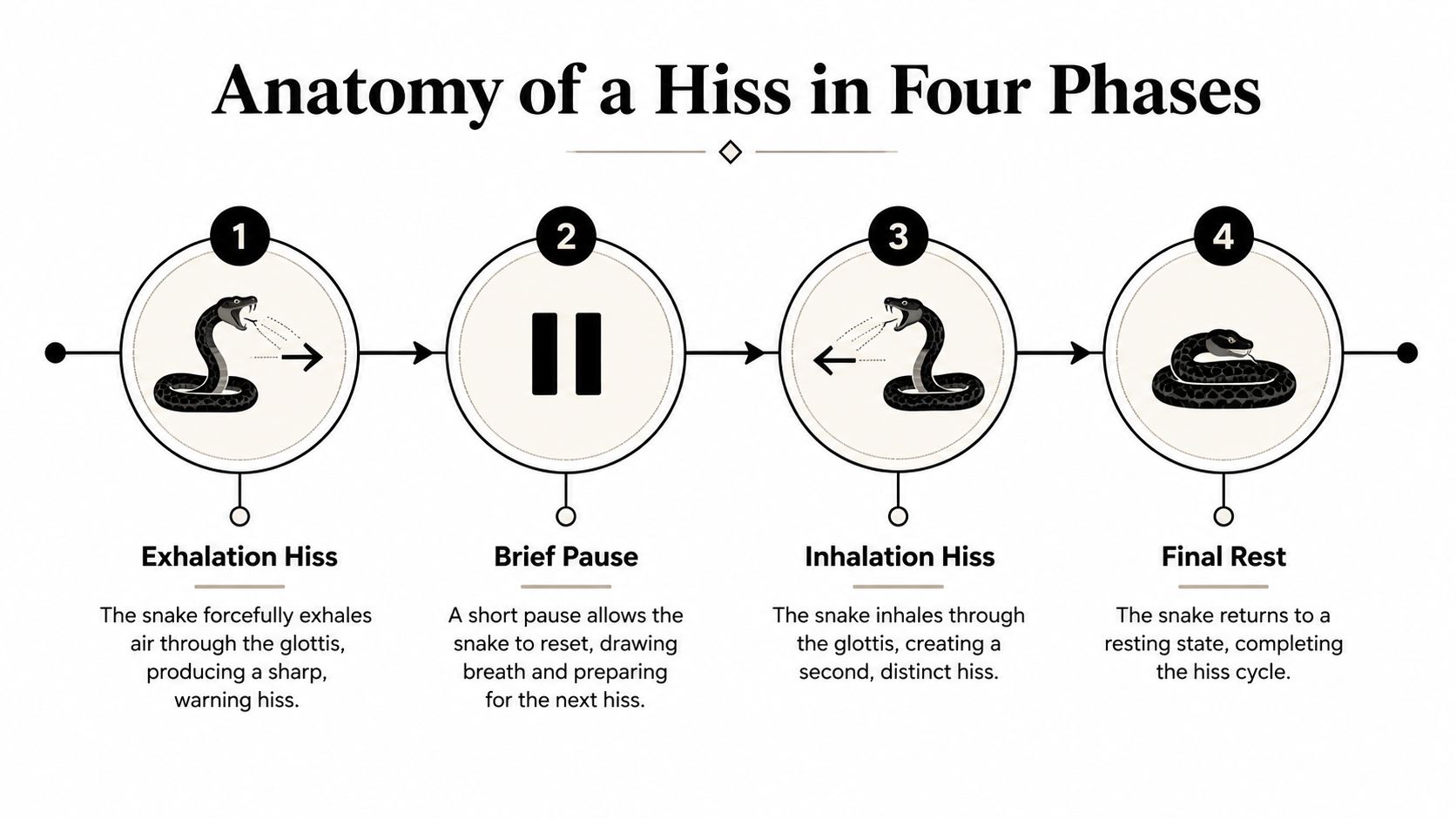
The useful breakthrough in the comparative research is that the hiss is not one continuous block. It can be quadriphasic, meaning it moves through exhalation, pause, inhalation, pause in a repeatable pattern, which gives the sound shape and timing rather than just volume. That structure helps explain why some hisses sound like a single burst and others feel like a sequence of warning pulses.
A timeline you can hear
The first phase is the outward hiss, the obvious one many recognize. Then comes a brief silence, followed by an inhalation hiss in species that produce it, and finally a rest phase before the next cycle. The comparative study measured average sample sizes of about 10.5 exhalations and 6.5 inhalations per individual, which gives the pattern enough repetition to matter rather than reading as a fluke. The same study reported hiss frequencies from 40 Hz to 12,000 Hz, showing how wide the acoustic range can be across species and individuals, with grass snakes concentrated at 5,000–10,000 Hz and vipers and viperine snakes dominated by 200–400 Hz. Comparative snake hiss study
Why the band matters
That frequency split is the part creators can hear. A higher cluster in the 5,000–10,000 Hz range reads as lighter, brighter, and often more brittle, while a hiss centered around 200–400 Hz reads heavier and closer to chesty breath or a low mechanical rush. The research also found inhalation hissing in 100% of vipers and only 25% of grass snakes, which tells you the same label, “snake hiss,” can hide very different acoustic behaviors. Comparative snake hiss study
Editing cue: if your clip has a noticeable inhale-like swell inside the hiss, don't treat it as a mistake. In some snakes, that phase is part of the real display.
For sound designers, the practical reading is straightforward. A hiss is not one standard waveform, it's a phased defensive sequence with different species leaning toward different frequency zones. That gives you more control, but it also means generic libraries flatten real variation into one reusable noise bed.
Why Snakes Hiss in the First Place
The function is defense, first and foremost. The classic biomechanics work on the puff adder showed a clear quadraphasic pattern and described many snake hisses as acoustically close to white noise, which means they carry broad, low-information energy rather than structured tonal content. That's a strong fit for warning behavior, because the sound says “back off” without needing to convey a detailed message. Puff adder sound mechanics
White-noise intimidation
White-noise-like sound is hard to ignore and hard to localize cleanly. For a predator or threat source, that makes the warning feel diffuse and physically annoying rather than precise, which is exactly the point. The hiss is not conversation, it's pressure.
The older stereotype says snakes are silent reptiles that only hiss at humans. The newer behavioral work from Australia complicates that idea by showing snakes respond to airborne and ground-borne sound in the 0–450 Hz range, and those responses differ by genus. In that study, 1 genus increased movement, 3 genera were more likely to move away from sound, and taipans increased defensive or cautious behavior. Australian snake sound-response study
What that means for storytellers
That does not turn a hiss into dialogue. It does suggest that sound is part of snake behavior in a more active way than pop explanations often admit. If you're building a wildlife segment or a tense scene, that nuance matters because the hiss is both a display to others and a sound the animal is living through in a noisy environment.
For educators and field recordists, the takeaway is useful. A snake hiss is evolutionarily old, behaviorally purposeful, and tuned to intimidation through broadband noise, but snakes themselves also react to sound and vibration in ways that invite more careful listening. That makes the topic richer than a simple scare effect.
Recording a Real Snake Hiss in the Field
A real hiss is usually messier than the clean clip in a library. You may get breath noise, cage resonance, movement, soil rustle, or a startled operator all at once, and that's normal. The goal is to collect a usable signal without forcing yourself into dangerous proximity.
Practical capture setup
A shotgun microphone or a small-diaphragm condenser is a sensible starting point, especially if you need focus and detail. Keep a working distance of 30 to 100 cm from the animal, use a windscreen, and make the environment as quiet as possible so HVAC and handling noise don't sit on top of the hiss. Record at 96 kHz / 24-bit if you can, because that gives you more headroom when you clean the file later.
Safety comes first. Never free-hand a mic near a venomous animal, and use cages or glass where possible so you're not trading fidelity for risk. In field work, a slightly less intimate recording is better than a dangerous one.
Quiet rooms help, but only up to a point. If the hiss energy sits near room rumble, the cleaner the environment, the more the hiss survives later processing.
What usually goes wrong
The most common problem is capture from too far away in a noisy place. The hiss is there, but the low end is crowded by wind or room hum, and the high end is smudged by reflections. Another common issue is overreaction from the person recording, which adds bumps and handling noise right when the snake shifts.
If you want a clip you can edit, think of the field session as raw material gathering, not final delivery. The next step is where the hiss becomes usable.
Cleaning and Isolating a Hiss Recording in Post
The first move in post is usually a high-pass filter to reduce rumble that lives below the useful hiss energy. That matters because the lower end is also where room noise and handling thumps like to hide, and a hiss doesn't need that weight to feel threatening. After that, gentle broadband noise reduction or spectral editing can pull away steady background noise without stripping the air out of the hiss itself.
Cleanup without flattening the texture
The danger is overcleaning. If you carve too aggressively, the hiss starts to sound phasey, thin, or synthetic, which is worse than leaving a little background. A light hand keeps the broad turbulent character intact.
If the animal startled the operator and the recording clipped, declipping may rescue the edge of the signal, but it won't restore what was never captured. That's why the best workflow starts with conservative gain staging in the field and ends with careful cleanup rather than heavy repair.
For creators who don't want to build that workflow from scratch in a full DAW, browser-based cleanup tools can handle hiss removal or separation from a broader recording with a simple prompt. A platform like ClearAudio is built around drag-and-drop upload, then letting you specify what to keep while the engine removes noise, hum, hiss, or room echo and isolates the useful material. Its quality modes, Small, Base, PRO Large, and PRO Large-TV, are useful when you need to balance speed against fidelity across short clips and longer sessions.
A clean order of operations
- Trim the file so you're only processing the section that matters.
- High-pass gently to remove rumble without hollowing the hiss.
- Reduce steady background noise with spectral editing or a careful subtraction pass.
- Check for clipping and repair only if needed.
- Listen in context with the scene, because a hiss that sounds perfect solo can disappear under dialogue or music.
The best result is usually not the cleanest possible file. It's the file that still sounds like an animal, not a computer artifact.
Choosing the Right Hiss for the Right Scene
A stock hiss should not be the default answer. A short exhalation-only burst reads like a fast warning and works well for a jump scare or a quick reveal, while a full quadriphasic cycle feels more sustained and suits a tense stare-down. The difference is not just length, it's dramatic intent.
Match the hiss to the emotional read
A low-frequency, viper-style hiss carries weight, age, and pressure. It suggests something grounded and dangerous. A bright, grass-snake-style hiss feels lighter and more brittle, which can work for a smaller animal, a nervous moment, or a scene where the threat is quick rather than monumental.
| Hiss Variant | Frequency Band | Best Used For |
|---|---|---|
| Short exhalation hiss | Lower or higher, depending on species | Jump scares, quick warnings, snap reactions |
| Full quadriphasic hiss | Species-dependent, often broader in feel | Sustained tension, threat displays, close-ups |
| Viper-style low hiss | 200–400 Hz dominated Comparative snake hiss study | Heavy menace, ancient danger, grounded fear |
| Grass-snake-style bright hiss | 5,000–10,000 Hz dominated Comparative snake hiss study | Nervous energy, small threat, agile movement |
The wrong hiss often sounds fake because it answers the wrong dramatic question. The right one makes the shot feel inevitable.
Before you drop a clip into a scene, ask four things. Which snake is implied, which breath phase is present, what frequency band dominates, and what should the audience feel right now. That checklist does more for realism than turning the clip up.
If you need cleaner snake audio, better control over hiss removal, or a faster way to separate the useful sound from field noise, try ClearAudio. It's built for creators who want to clean, isolate, and refine messy recordings without turning the process into a technical project, which makes it a practical fit for exactly this kind of audio work.